Coffee Packaging Guide
Select a coffee bag structure by the protection, sealing, printing and market requirements of the finished pack—not by appearance alone.
The Short Answer
Coffee packaging is commonly engineered as a laminated structure in which different layers perform different jobs. The outside supports printing and handling, a middle layer may provide oxygen, moisture or light barrier, and the inside supports sealing and direct product contact. The correct structure depends on the coffee, intended shelf life, valve and zipper, filling process, distribution conditions and destination market.
Think in Functions, Not Just Material Names
Outer print layer
Supports graphics, surface appearance and resistance to normal handling. Matte, gloss and kraft-look appearances require different design and converting decisions.
Barrier layer
Helps manage oxygen, moisture, aroma and light exposure according to the product and distribution requirement.
Sealant layer
Forms the inside sealing surface and must suit the product, heat-seal process, closure features and intended conditions of use.
Adhesive and converting system
Connects the selected layers into a finished laminate. Suitability must be confirmed for the complete structure and application.
A Common Supplied Structure Example
MOPP / VMPET / PE is one commonly supplied coffee packaging laminate. It is an example rather than a universal structure; the final construction depends on product, barrier, sealing and market requirements.
MOPP
Outer printing and surface layer.
VMPET
Metallized barrier layer.
PE
Inner sealing and product-contact layer.
Typical thickness
80–160 μm per pouch wall, customizable according to barrier, product and packing requirements.
Match the Structure to the Protection Requirement
| Project priority | Structure question | Buyer evidence to request |
|---|---|---|
| Aroma and oxygen protection | What barrier performance is required for the coffee and intended shelf life? | Confirmed material specification and any applicable test or supplier document |
| Moisture control | How will the pack be filled, stored and transported? | Specification matched to the actual conditions of use |
| Light protection | Does the product require an opaque, metallized or other light-control option? | Approved appearance sample and confirmed structure |
| Seal reliability | What sealing equipment, temperature window and contamination risk apply? | Seal trial or finished-bag sample using the intended setup |
| Market compliance | Which food-contact rules and destination requirements apply? | Available documents for the selected material, supplier and conditions of use |
Transparent, High-Barrier and Kraft-Look Options
Transparent window or clear pack
Visibility can support product presentation, but the transparent area and complete structure still need to meet the required protection and sealing performance.
Metallized or foil-based barrier
Opaque barrier options may be considered where oxygen, moisture or light protection is a priority. The exact construction and performance must be confirmed for the project.
Kraft-look presentation
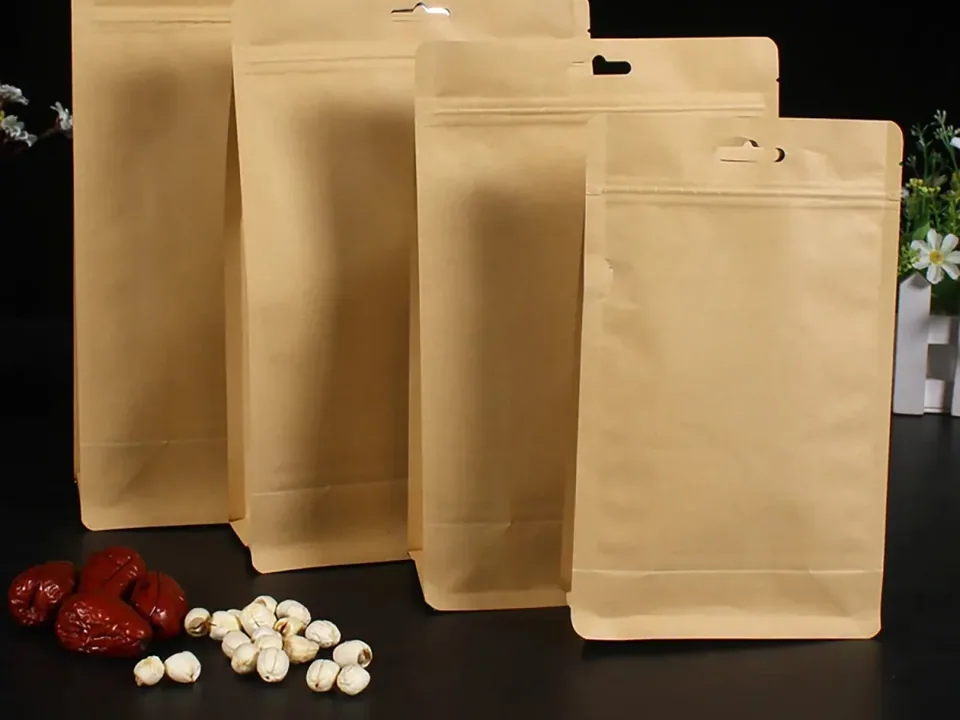
A kraft appearance does not automatically mean a paper-only package. Confirm the full laminate, food-contact layer, barrier level, print method and disposal claim before using sustainability language.
Food-Contact Suitability Is Application Specific
Food-contact status cannot be inferred from a generic film name. In the United States, the regulatory status and conditions of use of each relevant food-contact substance must be considered for the finished article. In the European Union, food-contact materials must meet the general framework and applicable material-specific rules.
Ask for documents that match the selected structure, material supplier, food type, temperature and destination market. Do not treat an unrelated certificate as proof for every structure.
Questions to Answer Before Choosing a Material
- Whole bean or ground coffee, roast type and target shelf life
- Bag style, size, zipper, valve and tear-notch requirements
- Desired transparent, opaque, metallic or kraft-look appearance
- Filling and heat-sealing equipment
- Storage, transport and destination climate
- Destination market and required food-contact documents
- Artwork, color and finish requirements
- Order quantity and target cost
Review the main coffee bag configurations and use the coffee bag size guide before finalizing a structure.
Technical Sources
These official references support the general technical and regulatory principles in this guide. Project documents must still match the selected material, supplier and conditions of use.
Buyer FAQ
Frequently Asked Questions
What is the best material for coffee bags?
There is no universal best material. The suitable laminate depends on the coffee, target shelf life, oxygen and moisture protection, light exposure, valve and zipper, sealing process, destination market and target cost.
Are kraft coffee bags made only from paper?
Not necessarily. Many kraft-look coffee bags combine a paper or paper-look outside with other functional layers. Confirm the complete structure, food-contact layer, barrier and disposal claim.
Do all coffee bags need a foil layer?
No. The required barrier can be achieved through different confirmed structures. Select the option by product protection, appearance, processing and market requirements rather than assuming one layer is mandatory.
Can a transparent coffee bag provide barrier protection?
Transparent high-barrier options may be available, but performance depends on the complete structure. Request the exact specification and verify it against the intended shelf-life and distribution conditions.
What food-contact documents should a buyer request?
Request documents that apply to the selected material, supplier, food type, conditions of use and destination market. The available document set should be confirmed before the order.
Confirm a Coffee Bag Structure
Share the coffee, target shelf life, bag style, appearance, features, filling method, market and quantity so the structure can be reviewed for the project.
Send Your Packaging Requirements
Share the product, format, size or fill target, material needs, artwork, quantity and destination. The form does not submit until you review and send it.